
Anne Böthig
Senior SEO Consultant
GEO – The essentials in brief:
- GEO Definition: Generative Engine Optimization (GEO) involves optimizing a digital presence to appear in the responses of generative AI systems, such as ChatGPT, Google AI Overviews, Gemini and Perplexity.
- Distinguishing GEO from SEO: GEO does not replace SEO; rather, it adds an extra dimension to it.
- Paradigm shift: GEO is investing more in brand visibility and less in traffic.
- GEO as a marketing channel: ChatGPT has over 900 million weekly active users (TechCrunch, 2026). Nowadays, the customer journey often starts with AI systems.
Generative AI is transforming the way people search for information and make purchasing decisions. While the customer journey used to start with a list of blue links, an AI system now often provides a ready-made answer, deciding which sources to cite and which brands to mention.
What is generative AI?
Generative AI refers to AI systems that can generate new content, such as text, images or videos. Text-based applications typically use large language models (LLMs). An LLM uses a probability-based approach to determine the most plausible sequence of words in response to an input (the prompt). The result is a response formulated in natural language. erzeugen. Textbasierte Anwendungen basieren dabei in der Regel auf Large Language Modellen (LLMs). Ein LLM berechnet wahrscheinlichkeitsbasiert, welche Wortfolge die plausibelste Antwort auf eine Eingabe (den Prompt) ist. Das Ergebnis ist eine formulierte Antwort in natürlicher Sprache.
The key difference from traditional search methods is how information is processed. A search engine indexes the web and returns documents. In contrast, a generative system synthesises an answer based either solely on its training data or on a real-time web search.
Three kinds of generative AI systems
Not all AI systems work in the same way. There are three distinct types that differ in terms of how, or even if, they access the web.
(1) AI Search Engines (Answer Engines & Search Companions)
- Systems access the current web index and summarise the content they find using a language model
- Sources are cited directly
- Examples: Google AI Overviews, Google AI Mode, Bing Copilot, Perplexity
(2) Conversational Assistants (Chatbots)
- Systems primarily rely on the model knowledge they have been trained on. A web search is only initiated at the user's request (e.g. through trigger words) or if the chatbot recognises that the database is incomplete
- Sources are not guaranteed
- Examples: Gemini, ChatGPT, Claude
(3) Static LLMs (No web access)
- LLMs rely solely on their training data, rather than performing web searches
- A brand's visibility can only be influenced by its presence in the training data. Therefore, a strong brand presence at the time of training is essential
- Examples: Models that can be accessed either via an API or in offline mode

What is Generative Engine Optimization (GEO)?
Generative Engine Optimization (GEO) involves strategically optimising a brand’s digital presence to appear as a relevant solution in the responses provided by generative AI systems. Related terms, such as Answer Engine Optimisation (AEO) and AI Optimisation (AIO), largely describe the same practice.
The objective of GEO differs fundamentally from that of traditional SEO. While traditional SEO focuses on achieving an organic ranking in a list of blue links to generate clicks, success in GEO is measured by the quality of presence within an AI response.
In this context, the following four key dimensions of AI visibility can be identified:
- Citation (Source link): The company's own website is either linked to or mentioned as a source in the AI response.
- Brand Mention: The brand or product is mentioned as a recommendation in the body of the AI response without a link to the company's domain necessarily being included. This contributes to brand awareness at the point of purchase.
- Brand Sentiment (Brand perception): Simply being mentioned is not enough. GEO actively controls how the AI talks about a brand. The image conveyed by the AI shapes consumer perception.
- Authority (Entity Relation): AI systems think in terms of entities (objects, people and brands) and their relationships with one another. At GEO, the goal is to link the brand semantically to a specific need so that, when users ask relevant questions, the language model calculates the brand as the most logical answer.
The mechanisms that determine visibility in generative AI systems are partly similar to SEO, but operate according to their own logic. Well-researched, data-driven and clearly structured content is favoured, while outdated SEO practices such as keyword stuffing are penalised.
What is the difference between SEO and GEO?
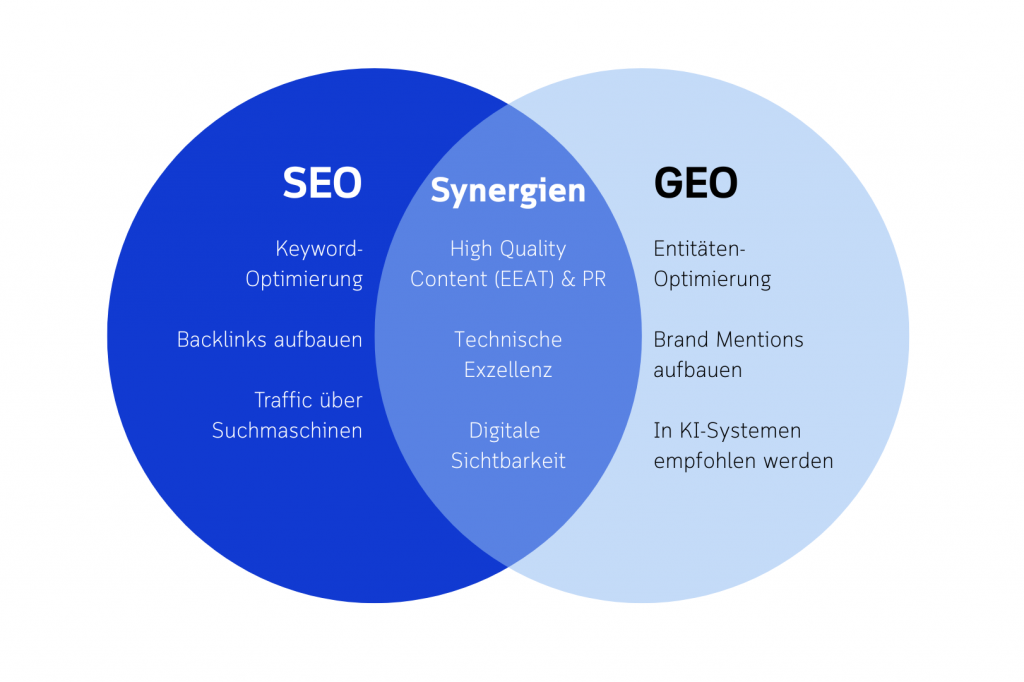
Firstly, the most important point: GEO does not replace SEO. GEO complements SEO. In practice, it is an additional layer that builds on a solid SEO foundation.
SEO is the foundation of GEO
- Technical aspects: crawlability, loading times, machine readability, structured data and clean page architecture.
- E-E-A-T: Experience, Expertise, Authoritativeness and Trust are signals used by both Google and AI systems to evaluate content.
- Value-added content: Content that answers a genuine question rather than just targeting keywords.
- PR and brand presence: Mentions in credible external sources.
SEO has been expanded to include GEO
However, beyond this common ground, Google Search and AI Search operate according to different principles. The following comparison illustrates the differences in their processes:
| Dimension | Classic Google Search | Generative AI |
|---|---|---|
| Input | Keyword input | Custom prompt (natural language) |
| Processing | Indexing, ranking | Model knowledge, probability calculation |
| Updates | Re-ranking | Grounding, web search |
| Output | Search results list | Customised, formulated answer |
| Metrics | Clicks, impressions, website traffic | Brand mentions, citations, brand sentiment |
While SEO strategies aim to generate organic traffic to a company's website, GEO aims to ensure the brand appears directly in AI responses and is recommended. SEO-Maßnahmen anstreben, organischen Traffic für die eigene Website zu generieren, zielt GEO darauf ab, als Marke direkt in der KI-Antwort präsent zu sein und empfohlen zu werden.
The evolution of the Google search engine makes it clear that Google is no longer simply returning results from its traditional index, but is instead providing contextual answers in the form of AI Overviews. With the introduction of AI Mode, Google is now even engaging in dialogue with users. There are many signs that Google is actively encouraging its users to move away from traditional web searches and towards direct AI dialogue. AI Overviews kontextuelle Antworten liefert und mittlerweile mit AI Mode auch Dialoge mit dem User führt. Vieles deutet darauf hin, dass Google seine User aktuell regelrecht erzieht: Weg von der klassischen Web-Recherche, hin zum direkten KI-Dialog.
Official figures from Google I/O in May 2026 demonstrate the effectiveness of these measures: On average, search queries in the new Google AI Mode are now three times longer. Users are entering fewer individual keywords and instead engaging in conversations with Google. The new search interface ensures that users remain in the chat after asking a question (Reid, 2026).
In what ways is generative AI changing the way SEO is used for marketing?
To illustrate the scale of this phenomenon, it is worth examining the latest figures. Generative AI is now a category in its own right, rather than a niche phenomenon.
- Google's AI Overviews reach over two billion people each month, spanning more than 200 countries and 40 languages (TechCrunch, 2025). 900 Millionen wöchentlich aktive Nutzer meldete OpenAI für ChatGPT im Februar 2026, mehr als eine Verdopplung gegenüber den 400 Millionen im Februar 2025 (TechCrunch, 2026).
- Google's AI Overviews reach over two billion people each month, spanning more than 200 countries and 40 languages (TechCrunch, 2025). 2 Milliarden Menschen erreichen Googles AI Overviews monatlich, ausgespielt in mehr als 200 Ländern und 40 Sprachen (TechCrunch, 2025).
Although the traditional Google search remains by far the largest channel, with billions of queries every day, an increasing number of these are being answered by Google AI Overviews before users even click on a result.
For marketing professionals, the key point is not simply reach, but the change in the customer journey. If an AI response conclusively answers the user’s question, they will not click through to a website. Studies clearly demonstrate this: Veränderung der Customer Journey. Wenn eine KI-Antwort die Frage des Nutzers abschließend beantwortet, entsteht kein Klick auf eine Website. Genau das belegen Studien deutlich:
- When an AI overview appears, users click on a traditional search result in only eight percent of cases, compared to 15 percent without an AI summary. Furthermore, only around 1 percent of users click on the sources cited within the AI overview (Search Engine Land, 2025). 8 Prozent der Fälle auf ein klassisches Suchergebnis, gegenüber 15 Prozent ohne KI-Zusammenfassung. Auf die innerhalb des AI Overviews zitierten Quellen klickten lediglich rund 1 Prozent der Nutzer (Search Engine Land, 2025).
- Further analyses report click-through rate declines of between 34 and 46 per cent as soon as an AI overview appears (Search Engine Journal, 2025). 34 und 46 Prozent, sobald ein AI Overview erscheint (Search Engine Journal, 2025).
This means that a brand’s digital visibility is not limited to its own website; it also extends to the AI responses themselves. GEO fills this gap perfectly.
When is GEO the right marketing channel?
As a marketing channel, GEO can contribute directly to overarching corporate goals.
- Increasing brand awareness: Companies mentioned in AI responses appear at the exact moment that users are actively searching for solutions or comparing options.
- Improve brand image: The way an AI talks about a brand (brand sentiment) is increasingly shaping consumer perception.
- Reaching new customers: AI systems already play a significant part in the information-gathering and decision-making processes. Recent studies on purchasing behaviour show that digital research platforms are the most important source of information for decision-makers. Having an AI presence determines which brands make it onto new customers’ shortlists.
One often-overlooked point is that: Traffic from AI systems has an above-average conversion rate. While purely informational pages are losing traffic due to the zero-click trend, data from Semrush and Adobe shows that this is not the case for transactional queries. Users coming from AI systems have already completed their initial research. They spend more time on the website and are more likely to convert (Superlines, 2026; TryAnalyze.ai, 2026).
How can I measure GEO?
The main challenge for GEO: A significant proportion of its impact does not generate traditional traffic, meaning it is initially invisible in standard marketing analytics systems. Nevertheless, GEO can be measured:
(1) Referral traffic via GA4:
AI systems that link to websites (e.g. Perplexity and ChatGPT) generate referral traffic. This traffic can be identified in GA4 by applying a regular expression (regex) filter to the referral source to capture the relevant AI domains (DiTomaso, 2026). This provides an initial quantitative overview of AI traffic, even if it only represents a small proportion of the total in absolute terms.
Regex for AI tools:
^(?:.*chatgpt\.com|openai\.com|claude\.ai|perplexity(?:\.ai)?|gemini\.google\.com|copilot\.microsoft\.com|deepseek\.com|grok\.x\.com|you\.com|mistral\.ai|phind\.com|huggingface\.co|quora\.com\/poe|character\.ai|deepl\.com|quillbot\.com|jasper\.ai|copy\.ai|writesonic\.com|notion\.so)$(2) Reporting from Bing and Google Search Console:
Bing Webmaster Tools already provide insights into AI visibility. For Google Search Console, AI-related reporting features are currently under development (Google Search Central, 2026). Together, these data sources provide a comprehensive overview by offering the search engine’s AI perspective.
(3) Prompt Monitoring
The essence of GEO measurement is the systematic tracking of whether and how your brand appears in AI responses. It makes sense to distinguish by prompt type.
- Transactional prompts: "Where can I find the best women's jeans?", "Is the brand mentioned in the recommendations?"
- Branded prompts: "How is Brand Y rated?", "What tone and sentiment does the AI use when discussing the brand?", "Does it understand the brand correctly, and does it convey its core values accurately?"
(4) Post checkout survey
As GA4 systematically underestimates the contribution of AI, a direct user survey can provide more insight. The “How did you hear about us?” field in the contact or checkout form often yields the most honest data about the actual role of AI systems in the customer journey.
GEO KPIs vs. SEO KPIs
GEO and SEO require different metrics. While SEO focuses on keywords, rankings, impressions, click-through rate (CTR) and clicks, GEO emphasises brand mentions, brand sentiment, citations and referral traffic. The ultimate goal of both disciplines remains conversions, leads and sales. However, while SEO focuses on traffic volume, GEO focuses more on brand visibility to achieve this goal. Brand Mentions, Brand Sentiment, Citations und Referral-Traffic in den Vordergrund. Conversions, Leads und Sales bleiben in beiden Disziplinen das gemeinsame Endziel. Der Weg dorthin verläuft bei GEO jedoch stärker über Markensichtbarkeit als über Traffic-Volumen.
Get started with GEO – First steps
It has been found to be effective to divide GEO measures into four areas of responsibility: strategy; monitoring; on-page optimisation (content and technology); and off-page optimisation.
(1) Define GEO goals
- Increase brand awareness: Ensure that your brand is mentioned in relevant AI responses.
- Lead generation/sales: Be mentioned in transactional recommendations.
- Positive brand perception: Influence how AI systems talk about the brand.
(2) Technical SEO: Is the website accessible to AI systems?
Before optimizing the content, ensure that AI systems can crawl and machine-read the website. The most important factors are:
- Controlling AI crawler access: If the AI crawler is blocked (e.g. via robots.txt), the website will not appear as a source in the corresponding system. A prominent example: A website that blocks the OpenAI crawler cannot be cited by ChatGPT.
- Content without JavaScript rendering: Most AI crawlers currently do not render JavaScript. Important content must therefore be available server-side in HTML.
- XML sitemaps: Provide relevant URLs.
- Optimize Core Web Vitals.
- Site architecture and internal linking: Create a logical structure that makes important content easy to find.
- Schema markups: Incorporate structured data into the website.
- Optimize shopping feed: Relevant for e-commerce.
(3) GEO optimized content
In order for AI systems to accurately capture and convey a brand’s messages, these must be communicated consistently across all channels. Semantic clarity is crucial. The brand should be associated with a clear need and reiterate that message consistently. Botschaften einer Marke korrekt aufgreifen und weitergeben, müssen diese über alle Kanäle hinweg konsistent gesendet werden. Semantische Klarheit ist entscheidend: Die Marke sollte mit einem klaren Bedürfnis verknüpft sein und diese Botschaft konsistent wiederholen.
At the level of individual pieces of content, the principle of content chunking applies: content is divided into clearly defined, self-contained units of meaning. Each section should address exactly one main idea, begin directly with the core message and remain as self-contained and understandable as possible. The reason is that: AI systems extract and quote individual passages. The more self-contained a passage is, the easier it is to quote. The following approaches have proven particularly effective: Content-Chunkings: Inhalte werden in klar abgegrenzte, in sich geschlossene Sinneinheiten gegliedert. Jeder Abschnitt behandelt genau eine Hauptidee, beginnt direkt mit der Kernaussage und bleibt möglichst eigenständig verständlich. Der Grund: KI-Systeme extrahieren und zitieren einzelne Passagen. Je sauberer eine Passage für sich allein steht, desto leichter kann sie zitiert werden. Konkret bewährt haben sich:
- Question-and-answer structures with direct answers
- Meaningful headings, bullet points, tables and summaries at the beginning
- Content that adds genuine value, such as first-hand experience, data, tests, opinions, comparisons, pros and cons overviews, tools and multimedia formats
- Timeliness: AI systems prefer fresh, accurate data. Several analyses show that content that has been updated recently appears significantly more often in AI responses
(4) Off-page: Generating brand mentions from third-party domains
The majority of brand mentions in AI responses do not come from the brand’s own website, but from third-party sources. nicht von der eigenen Website, sondern von Drittquellen.
Only around 10 per cent of citations in LLM responses referred to the brand’s own domains; the remaining 90 per cent referred to sources outside the brand’s control. These include Reddit threads, YouTube videos, review platforms, comparison articles and community forums (Foundation/AirOps, 2026). The specific sources vary depending on the industry and sector.
Almost 90 per cent of third-party mentions originate from listicles, comparison sites, and review sites. Around 80 per cent of the brands mentioned appear in the top three positions on these sites (AirOps, 2026).
This leads to a clear strategic conclusion. Owned content (your own website) provides the foundation, but earned content (external mentions) also plays a significant role in increasing AI visibility. The two must work together strategically. The most appropriate off-page measures depend heavily on the industry. For example, relevant sources for a SaaS company differ from those for an e-commerce retailer. Owned Content (die eigene Website) bildet die Basis, aber Earned Content (externe Erwähnungen) trägt maßgeblich zur KI-Sichtbarkeit bei. Beides muss strategisch zusammenwirken. Die passenden Offpage-Maßnahmen hängen dabei stark von der Branche ab. Relevante Quellen für ein SaaS-Unternehmen sind andere als für einen E-Commerce-Händler.
Sources
- AirOps (2026): The 2026 State of AI Search
- DiTomaso, D. (2026): How to Track and Report on Traffic from AI Tools (ChatGPT, Perplexity) in GA4
- Google Search Central (2026): Introducing Search Generative AI performance reports in Search Console
- Reid, L. (2026): A new era for AI Search. Google Keyword Blog
- Superlines (2026): AI Search Statistics 2026
- TechCrunch (2026): ChatGPT reaches 900M weekly active users
- tryanalyze.ai (2026): AI Traffic Is Around 1% of the Web. Clicks Aren’t Everything
About the author

Anne Böthig
Senior SEO Consultant
Over five years ago, Anne discovered her passion for SEO and designing interactive websites that both users and Google love. She focuses on achieving the perfect balance between strong E-E-A-T and technical optimisation. As search is constantly evolving, innovation is key on every page. GEO is the standard of tomorrow.